
Improving Insulation in Your Home
“Actions for a greener, healthier future!”
Stopping heat loss is the most effective way to lower energy bills. In an uninsulated home, at least one-quarter of heat is lost through the roof, and about one-third escapes through the walls.
Draughtproofing & DraughtBusters
- The first, cheapest, and easiest step is to stop draughts by proofing all doors, windows, holes, and chimneys.
- RBWM DraughtBusters: A volunteer service that will fix your draughts for free.
- Contact: Email or visit the DraughtBusters website.
- For a deeper understanding of costs and paybacks for cavity wall, roof, and floor improvements, visit the Energy Saving Trust.
Loft Insulation
- After fixing draughts, this action typically saves the most money. If your loft is accessible and free of damp, it is often a DIY task.
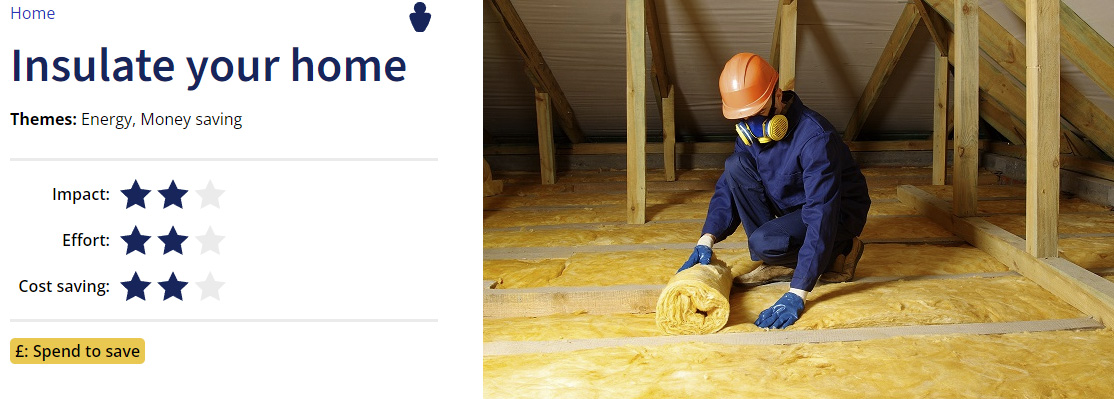
- Installation: Use rolls of mineral wool. Lay the first layer between the joists, then a second layer at right angles to reach the required depth.
- Savings: For a semi-detached house with no current insulation, adding up to 270mm costs about £900 but saves approximately £230 per year.
- Detailed costs and savings can be found at Energy Saving Trust – Roof and Loft Insulation.
Insulating Walls
Most UK houses have either Cavity Walls or Solid Walls:
- Cavity Walls (Post-1920s): Identified by an even brick pattern (all bricks laid lengthways). Specialists drill 22mm holes and blow in mineral wool or beads.
- Cost/Saving: Approx £2,700 to install; saves about £265 per year. See EST Cavity Wall Advice.
- Solid Walls (Pre-1920s): Identified by alternating brick patterns (some brick ends visible). These require internal or external insulation.
- External Wall Insulation: Approx £11,000.
- Internal Wall Insulation: Approx £7,500.
- Saving: About £320 per year.
Floor Insulation
- Only the ground floor needs insulation. Solid concrete floors can be topped with rigid insulation.
- Suspended Timber Floors: Identified by air bricks below floor level. Do NOT block air bricks.
- Methods: Lift floorboards to lay mineral wool supported by netting (saves ~£75/year) or use a “Q-Bot” robotic device to spray foam insulation underneath without removing boards.
Windows
- Energy-efficient windows (double or triple glazed) use frames (uPVC, wood) to stop heat transfer.
- A set of A-rated windows for a semi-detached house typically costs £15,000.
- Lower-cost alternatives include installing secondary glazing or using heavy curtains.
Technical Resources & Information Sources
- Centre for Alternative Technology (CAT) – Free Information Service.
- Green Building Forum – Community discussions.
- AECB – The Association for Environment Conscious Building.
- GreenSpec – Detailed Housing Retrofit strategies.
- Understanding U-Values: Learn how insulation performance is measured at Vesma or Ecomerchant.
For more information, visit the ECO Action Hub in Maidenhead.
Date Published: 11/01/2025 | Written by: Dave Scarbrough | Reviewed by: Paul Conacher
Note: This factsheet provides information only and does not constitute advice. Verify applicability to your circumstances before making decisions.